How Barndominiums Become Healthy Homes
7 Requirements to Turn a Barndominium into a Healthy Home
Barndominiums have earned a reputation for being inexpensive to build and beautiful to live in. When they’re built as pole barns, the inexpensive part is true. But when finished and detailed as an actual home, especially a high-performance one, barndominium becomes an architectural style, like farmhouse or craftsman. The structure under the skin is what determines whether you’re getting a home or a very nice-looking shed.
The distinction matters enormously if you want a healthy home.
Let’s Start With What a Pole Barn Actually Is
A pole barn is a post-frame structure: large-diameter poles or posts set into concrete footings in the ground, with roof trusses spanning between them. The wall system infills between those posts. It’s an elegant, efficient system for what it was designed to do: store equipment, house livestock, and shelter tractors from weather.
A pole barn was not designed to house people, and the design decisions that make it economical for agricultural use create real problems when you try to turn it into a healthy, durable, high-performance home. The following diagrams illustrate the difference between the two approaches, pole barn vs. healthy home:
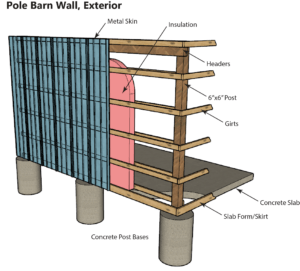
Pole barn walls are very simplistic.
This is a typical pole barn exterior wall. Wood poles are set into holes, which are then filled with concrete. Girts are attached to the poles, which will support the exterior and interior (if used) metal skin. Insulation can be placed between the interior and exterior girts. In a pole barn, virtually zero effort is made to seal drafts. A floor slab can be poured inside the building. Here is a cross-section of the wall:
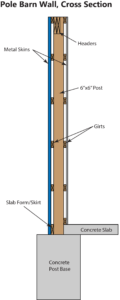
The cross section of a traditional pole barn shows no continuous building layers from wall to foundation.
Contrast this with the wall detail of a healthy home:
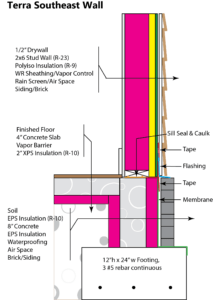
The wall section of a healthy home is complicated and built with strict adherence to building science.
This is our standard wall section for Tennessee. It is a very high performance assembly that provides the four required continuous building layers of a high-performance home: water barrier, air barrier, thermal blanket, and water vapor control. As you can see in the diagrams, the wall section of a healthy home is much more complex than a pole barn. Building a home as airtight as possible, which is required for a healthy home, involves many different products, including tapes and sealants. Let’s take a look at some of the differences in the wall sections, one at a time.
The Problems, One at a Time
1. There Is No Foundation
A conventional home sits on a continuous perimeter foundation, typically a poured concrete wall or block system bearing on footings below the frost line. That foundation does several things simultaneously: it transfers structural loads to the earth, it keeps the floor slab isolated from frost movement, and it provides a defined thermal and moisture boundary at grade.
A pole barn has none of that. Structural stability comes from poles set in concrete, which works fine for keeping a roof over a tractor. But poles spaced eight to twelve feet apart create a very different load path than a continuous foundation wall. Wind generates uplift forces across the entire roof and wall area. Widely spaced poles may not provide sufficient resistance to keep the structure anchored through a serious wind event. More critically, the absence of a perimeter foundation means the floor slab is directly subject to frost heave, the seasonal movement of soil as it freezes and thaws. That movement cracks slabs, disrupts mechanicals, and creates gaps in your building envelope that never fully close.
2. Air Sealing Is an Afterthought, or Not a Thought at All
Pole barns are built to be dry, not airtight. The goal is to keep rain out and wind off, not to control the movement of conditioned air. Gaps around posts, at the eave line, and at grade transitions are simply not addressed. For a storage building, that’s fine. For a home, especially a healthy home, uncontrolled air infiltration is where you lose energy, import moisture, and invite pollutants. You can’t manage indoor air quality if you can’t manage the air boundary.
Achieving the air tightness required for a healthy home means building a defined, continuous air control layer. That’s a design intent, not a retrofit. Pole barns weren’t designed with one.
3. Moisture Management
Metal cladding with no vapor management strategy is a recipe for condensation. Cold surfaces plus warm humid interior air equals moisture. Moisture in a wall assembly, left unmanaged, leads to mold, rot, and degraded insulation performance. In a storage building, you accept some of that as a cost of doing business. In a home, that’s a health and durability problem.
A healthy home requires a deliberate moisture management strategy: a defined vapor control layer, a drainage plane, and in humid climates like Tennessee, a dedicated dehumidification system to manage interior relative humidity. None of that is part of a standard pole barn specification.
4. Interior Finishes Aren’t Incidental
Pole barns are typically lined with metal panels, OSB, or plywood, materials appropriate for agricultural use. Homes have different expectations, for example drywall, real trim, doors with weatherstripping, and insulated windows with properly flashed rough openings. The cost difference between “pole barn interior” and “house interior” is substantial and easy to underestimate when you’re working from a pole barn quote.
5. Electrical and Plumbing
The National Electrical Code has specific requirements for residential occupancy that simply don’t apply to agricultural structures: outlet spacing, arc-fault protection, bathroom and kitchen circuit requirements, and others. The same principle applies to plumbing. When you change the occupancy classification from agricultural storage to residential, you change the entire code framework governing the installation.
6. The Code Gap
This is the one most people don’t know about. Agricultural pole barns frequently occupy a different regulatory category than residential structures, and in Tennessee, the picture is even more permissive than most people realize.
Many Tennessee counties have no building code enforcement at all. A permit means filling out a form and paying a fee. No plans review, no inspections, no sign-off. In those jurisdictions, the only state-level inspections required are electrical and septic. That’s it.
What that means practically: in a significant portion of Tennessee, nothing in the regulatory framework would prevent someone from moving into a pole barn. No inspector will come. No one will check the insulation, the air barrier, the structural connections, or the mechanical system. The accountability is entirely on the builder and the buyer.
We don’t find that reassuring, we find it clarifying. The building code, where it exists, represents the quality floor, not the ceiling. It’s the minimum acceptable standard for human occupancy, arrived at over decades of failures and lessons learned. When that floor is absent, the only thing standing between you and a building that’s merely legal is whether your builder understands the difference between a barn and a home.
7. HVAC: You Need a Real System
A pole barn might have a small unit conditioning an office corner. Converted to a home, some will install a central heat and air system. That’s not good enough. A healthy home requires a complete mechanical system custom designed for the home: heating and cooling sized to the actual load, dedicated ventilation to maintain indoor air quality, and in climates like Tennessee, a dedicated dehumidifier. These systems must be designed together, around a well-sealed, well-insulated envelope. You cannot bolt a proper HVAC system onto an uncontrolled enclosure and get a healthy result. The building has to be designed for it.
What All of This Means
If you want a healthy barndominium, here’s the honest answer: you need to build a home with barndominium aesthetics. That means a proper perimeter foundation with footings below frost depth, a thermal and moisture barrier at grade, continuous insulation without thermal bridges, a defined and tested air control layer, real windows properly flashed, a mechanical system designed for the building, interior finishes to residential standards, and the full residential code inspection process in counties where that process exists. Once you’ve addressed all of those items, you’re not building a pole barn. You’re building a home that looks like a barndominium, and those are genuinely different things.
Here’s the good news: the barndominium style is legitimate and buildable to a high-performance standard. Soaring ceilings, exposed structure, large open spans…none of that is incompatible with passive-house level performance. We can build you one, but we’ll be building a house, not a converted barn. If you love the barndominium look, let’s build one the right way. What we won’t do is hand you a pole barn and call it a home.