
Allergy Free Homes in Tennessee: 3 Things Your House Must Get Right
If you’re searching for an allergy free home, you’ve probably already tried everything: HEPA purifiers in every room, allergen-proof mattress covers, a humidifier in winter and a dehumidifier in summer. You take your medication as prescribed and follow your allergist’s advice. And yet you still wake up congested.
Here’s the uncomfortable truth: no amount of gadgets can fully compensate for a house that wasn’t designed to manage allergens in the first place. The good news is that a genuinely allergy free home is no longer just marketing language, it’s an engineering outcome, achievable with the right construction approach.
This post breaks down what actually makes a home better or worse for allergy and asthma sufferers, what the research says about the indoor environment, and what to look for if you’re house-hunting or building new.
The Indoor Air Quality Problem
Most allergy advice focuses on the outdoors: check the pollen count, keep windows closed on high-pollen days, shower after being outside. All of this is reasonable, but it misses a bigger issue.
The EPA estimates indoor air can be two to five times more polluted than outdoor air, and the average American spends about 90% of their time indoors. Combine those facts, and the math is stark: for most people with allergies, the majority of their allergen exposure happens inside their own home.
This isn’t a niche problem in the Southeast. Knoxville is regularly ranked among the top 30 allergy capitals in the country, and the Tennessee allergy season stretches from February through November. Oak, hickory, birch, ragweed, and grass pollens cycle through nearly the entire year, while high regional humidity creates ideal conditions for mold and dust mites indoors. If you live in or are moving to the greater Nashville, Chattanooga, or Knoxville area, your home’s indoor environment matters even more than it would somewhere drier or with a shorter pollen season.
So what makes a typical home’s indoor air a problem and what separates it from a true allergy free home? It comes down to three things: humidity, filtration, and the building envelope.
Allergy Free Home Factor #1: Humidity Control
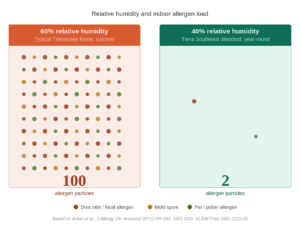
If there’s one number worth remembering, it’s this: dust mites cannot survive when relative humidity stays below 50%. Dust mites don’t drink water, they absorb moisture vapor directly from the air through specialized glands. Below that 50% threshold, they can’t maintain their internal water balance and their populations collapse.
Research published in the Journal of Allergy and Clinical Immunology tracked homes where indoor relative humidity was kept below 51% for 17 months. Live dust mite counts dropped from 401 per gram of dust to just 8, a 98% reduction. Mold follows a similar pattern in reverse, with colonies activating within 14 to 16 hours once humidity climbs above 60%. Both the EPA and NIH recommend keeping indoor relative humidity in the 30–50% range. (Arlian et al., 2001, J Allergy Clin Immunol, 107(1):99–104. DOI: 10.1067/mai.2001.112119)
Most homes have no dedicated way to manage humidity. Your air conditioner removes some moisture as a side effect of cooling, but it’s not designed to hold humidity in a specific range. In spring and fall, when the AC barely runs, humidity can climb unchecked. A typical Tennessee home often swings between 55% and 75% RH during warmer months, squarely where both dust mites and mold thrive.
What’s the fix? A dedicated, whole-home dehumidifier that operates independently of the air conditioning system. This is the single most impactful mechanical system for allergy control, and it’s something almost no production-built home includes as standard.
Allergy Free Home Factor #2: Filtered Air
Every home exchanges air with the outdoors, that’s unavoidable and even necessary. The question is whether that air passes through a filter before you breathe it.
In a typical home, the answer is largely no. Air infiltrates through dozens of small, uncontrolled gaps, around electrical outlets, attic bypasses, window and door frames, gaps in framing, none of which have any filtration. Whatever is in the outdoor air on a given day, from tree pollen to wildfire smoke, comes in freely.
Filter quality also varies enormously. Most homes use whatever came with the HVAC system, often a basic fiberglass filter capturing roughly 15% of particles. A MERV-13 filter, by contrast, captures 75–85% of particles in the 0.3–1.0 micron range and over 90% between 1 and 3 microns, covering the size range of pet allergens, mold spores, and dust mite waste particles. But filtration only helps if the air actually passes through it. A high-efficiency filter on your HVAC system does nothing for air entering through a gap around a window frame.
What’s the fix? An Energy Recovery Ventilator (ERV), a system that continuously brings in fresh outdoor air, filters it, and exhausts stale indoor air while exchanging heat between the two airstreams for efficiency. Paired with MERV-13 capable filtration, an ERV means essentially all the air entering your home has been filtered. This is a defining feature of any genuinely allergy free home.
Allergy Free Home Factor #3: The Building Envelope
The “building envelope” is everything separating your conditioned indoor space from the outdoors: walls, roof, windows, doors, foundation, and every seam and penetration in between. Its tightness is measured with a blower door test, which depressurizes the home and calculates air leakage at a standardized pressure, usually 50 pascals. It’s not an ear-popping pressure change, but it’s enough for accurate measurements. The result is expressed as air changes per hour at 50 pascals, or ACH50.
A typical existing U.S. home tests at 7 to 15 ACH50. Even a newly built code-minimum home often comes in around 3 to 5. At these leakage rates, there’s no meaningful barrier between indoor and outdoor air. Pollen, mold spores, and fine particulates move through the envelope as freely as air does.
When I tell people we try to build homes as airtight as possible, I sometimes receive pushback along the lines of, “but houses have to breathe!” It’s true, houses do have to breathe. But they don’t have to breathe through drafts. By adhering to building science when constructing the building envelope and installing HVAC systems designed for the Tennessee climate, we can carefully control the air and water vapor movement throughout a home.
What’s the fix? Homes built to a verified airtightness standard, ideally 1.0 ACH50 or below, confirmed by an actual blower door test. This type of building envelope eliminates uncontrolled infiltration pathways and works with the HVAC system to control water vapor. It’s the structural foundation of an allergy free home.
The Standard That Verifies All of This: Passive House
You might be wondering how you, as a buyer, are supposed to evaluate any of this. You can’t see air leakage rates or humidity control systems in listing photos, and builder marketing language, phrases like “energy efficient,” “healthy home,” and “premium construction” are largely unregulated and often mean very little.
This is where a builder with proper training and certification matters. Passive house is the most rigorous voluntary building performance standard in North America, and PHIUS (Passive House Institute US) is the organization that certifies new homes if you choose to go down the path of certification. A passive house home isn’t just designed to meet certain targets, it’s tested with an actual blower door test confirming the airtightness claims. It’s the difference between a builder merely telling you a home is healthy and efficient versus providing the receipts.
A home built to PHIUS standards in Tennessee typically includes, as a baseline:
- An airtight envelope verified at or below 0.6 ACH50
- Continuous insulation with no thermal bridges
- An ERV system providing continuous filtered fresh air
- A dedicated dehumidification system maintaining 35–45% relative humidity year-round
- High-efficiency filtration (MERV-13 or better) integrated into the HVAC system
A 2024 literature review of residential Passive House dwellings concluded that indoor air quality in these homes is generally better than in conventional construction, a finding that lines up with what the individual research on humidity, filtration, and airtightness would predict. (Rojas, Fletcher, Johnston, and Siddall, 2024, Energy and Buildings, vol. 306. DOI: 10.1016/j.enbuild.2023.113883)
What an Allergy Free Home Is Not
It’s worth being direct about the limits here, because overpromising helps no one. A high-performance home is not a cure for allergies, and no builder should claim otherwise. Research on filtration alone, for example, shows modest but real improvements in symptoms and sleep quality, but not elimination of symptoms, and not a substitute for medication or treatment your allergist has prescribed.
What a well-built allergy free home does do is remove a major, persistent source of allergen exposure that’s otherwise almost impossible to control through behavior alone. You can’t out-vacuum a house that’s constantly pulling in unfiltered outdoor air, and you can’t out-purify a house where humidity swings create ideal mite and mold conditions every summer. The building itself either works with you or against you, and for most homes, it’s working against you without anyone realizing it.
Buying vs. Building: What to Ask
If allergies or asthma are a factor in your home search, here are the questions worth asking of a builder, an agent, or about any home you’re considering:
- Has this home had a blower door test? What was the result (ACH50)?
- Is there a dedicated whole-home dehumidifier, separate from the air conditioning system?
- Does the home have an ERV or similar balanced ventilation system?
- What filtration level (MERV rating) does the HVAC system use?
- Is the home certified to any third-party performance standard, such as PHIUS?
If you’re building new rather than buying existing, these aren’t upgrades to bolt on later, they’re decisions made in the design stage. For families managing allergies or asthma in Middle and East Tennessee, a home engineered around these principles, and verified, not just promised, can be one of the most meaningful changes you make to your daily environment. It won’t replace your allergist, but it might mean you need them a little less.
If you’re exploring new construction or a custom build in the Greater Nashville, Chattanooga, or Knoxville areas and want to talk through what a passive house, allergy free home could look like for your family, Terra Southeast is happy to help. Fill out our contact form at terrasoutheast.com/contact, or reach Jason at 615-898-9115 or Sumeet at 423-558-4650. You can also email us at jason@terrasoutheast.com or sumeet@terrasoutheast.com. Let’s get started on your next project.