
Passive House in Tennessee’s two Climate Zones
Tennessee spans two climate zones. Your building science needs to account for both.
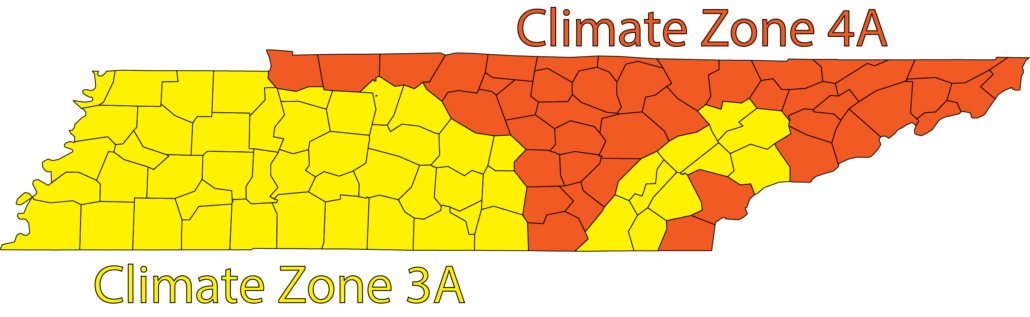
Tennessee is a multizone state. According to Passive House Institute U.S. (PHIUS) climate data, most of the state falls in Climate Zone 3A (hot-humid) but a meaningful portion, particularly in the east, remains in Climate Zone 4A, which is mixed-humid. That’s not a trivial distinction. The dominant loads, the vapor dynamics, and the most likely failure modes differ enough between those two zones that a single set of rules won’t serve both.
This matters practically, not just academically. It affects how we design wall assemblies, how we configure mechanical systems, and where the risks are if we get it wrong. A house designed as if Nashville and Johnson City have the same climate will eventually remind you that they don’t.
Sensible Load vs. Latent Load
Almost every house in Tennessee is built with an HVAC system that addresses the temperature of the home. Changing the temperature of the home is the sensible load on HVAC system. What normal homes don’t address is the latent load. Latent load is the energy required to adjust the humidity without adjusting the temperature. In Zone 3A (e.g., Nashville, Memphis, and Chattanooga), humidity can be oppressive and it’s not enough that your home’s air conditioner is the only source of dehumidification. The cooling season is long, the air is frequently near saturation, and your traditional, drafty home is letting in a ton of water vapor. And when you open a door in July…yuck.
A standard air conditioner removes some moisture as a byproduct of cooling air below its dew point. That part is good, but when the AC doesn’t run, your inside air can still get sticky. This is the reason HVAC pros will counsel against oversizing the AC: a unit larger than the home needs will cool it down quickly, but will not run long enough to remove a lot of humidity. You can have a perfectly comfortable 72°F interior sitting at 65% relative humidity. That’s not healthy, it’s a mold incubator with good furniture.
Zone 4A has a more balanced profile: more significant heating loads, somewhat less brutal humidity. But the shoulder seasons introduce their own latent complications. In spring and fall, outdoor air can carry substantial moisture at temperatures that don’t trigger the cooling system at all. The latent problem doesn’t disappear in Zone 4A. It just shows up on a different schedule.
A tight building envelope, in either zone, is necessary. It is not sufficient.
Our HVAC Answer: Three Subsystems, One Goal
At Terra Southeast, we design HVAC systems using three discrete subsystems, each with a specific job. They work together, they don’t substitute for each other.
Temperature control via heat pump. A properly sized heat pump handles sensible heating and cooling, moving the thermometer. In a passive house, these systems run small by conventional standards, because the home’s envelope is so much better insulated and more air tight. In our homes, we typically use systems less than half the size—sometimes a quarter—of systems in code-built homes. We’re not compensating for a leaky shell with an oversized mechanical system, and we run the calculations on every home we build. No HVAC rules of thumb here.
Fresh air via ERV. An Energy Recovery Ventilator delivers a controlled quantity of fresh outdoor air while exchanging heat and moisture with the outgoing exhaust air stream. In summer, it pre-conditions incoming humid outdoor air before it enters the living space, recovering a significant portion of the cooling energy that would otherwise be wasted. In winter, it captures heat from the exhaust air and uses it to pre-warm incoming cold air. In both zones, you get continuous fresh air without paying the full energy penalty of conditioning raw outdoor air. The ERV earns its cost every month of the year in Tennessee.
Dedicated dehumidification. This is the piece that solves the latent problem directly. A standalone dehumidifier, sized and controlled independently of the cooling system, removes moisture from interior air on its own schedule, regardless of whether the heat pump is running. It can maintain relative humidity in the 45–50% range year-round, including during those shoulder-season weeks when temperatures are mild but the outdoor air is carrying plenty of moisture. In Zone 3A, this is non-negotiable. In Zone 4A it’s nearly so, particularly for buildings at passive house airtightness levels, where incidental drying through infiltration is essentially zero.
Together, these three systems, operating inside a sufficiently airtight building envelope, produce something most Tennessee homes have never achieved: air that is consistently fresh, at the right temperature, and at the right moisture level. That’s not just a comfortable home, that’s a genuinely healthy one.
The Vapor Drive Problem: It Runs Both Directions
This is where the multizone reality gets interesting for wall assemblies. In a purely hot climate, vapor drive is simple: moisture pushes inward from the hot, humid exterior. In a purely cold climate, the reverse is true. Tennessee is neither. It’s both, seasonally, and that’s especially pronounced in Zone 4A, where winter heating loads are high enough to create meaningful outward vapor drive that Zone 3A barely sees.
An assembly that stops all vapor movement in one direction traps moisture in the other. That’s how you rot a wall quietly, over several years, before anyone notices.
The design principle that works across both zones: manage vapor entry points, create a clear drying path, and never sandwich moisture between two low-permeance layers. In Zone 3A, where inward summer drive is the primary threat, the exterior continuous insulation needs to be substantial enough to keep the sheathing above the dew point during the cooling season. In Zone 4A, where outward winter drive is a co-equal concern, the interior side of the assembly needs to remain more vapor-open than the exterior, allowing the wall to dry inward when conditions require it.
In our assemblies, we typically use Zip R-9 sheathing as a combined structural sheathing, water-resistive barrier, continuous insulation layer, and primary air control layer. The R-9 continuous insulation keeps the sheathing warm enough in winter to reduce condensation risk, and limits inward vapor drive in summer. A rain screen gap between the cladding and the sheathing allows the exterior to dry outward. The interior assembly is intentionally more vapor-open than the exterior. The goal is never to create a vapor-impermeable wall. The goal is to ensure moisture can leave faster than it arrives, in either direction, in either season.
In Zone 4A specifically, we pay particular attention to the interior vapor profile. More heating degree days means more sustained outward drive during winter. If the interior finish assembly is too vapor-retardant, you’re creating a moisture trap on the warm side of the wall. That’s a detail that matters more in Knoxville than in Memphis, and it’s the kind of thing that doesn’t show up in generic green building guidance.
Why This Complexity Is Actually the Point
The passive house standard doesn’t flatten regional climate differences into a single comfortable average. It sets performance targets that are specific to where you’re building, which is exactly why PHIUS develops climate-specific datasets rather than applying one national rulebook.
Tennessee’s multizone reality isn’t a complication to work around. It’s the information you need to build correctly. A house in East Tennessee and a house in Middle Tennessee face different dominant challenges, and they should be designed accordingly.
That’s what we do. When you build with Terra Southeast, you’re not getting a house designed for a theoretical climate or a convenient average. You’re getting a house designed for the specific conditions of your site, with assemblies that manage real, seasonal vapor dynamics and mechanical systems that address the latent load directly, rather than hoping the central air conditioning handles it as a side effect.
In Tennessee’s summers, its shoulder seasons, and its increasingly variable winters, hope is not an HVAC strategy.
Terra Southeast is Tennessee’s first PHIUS-certified passive house builder. If you’re considering high-performance construction in the mid-South and want a direct conversation about what it actually takes and what it costs, we’d be glad to talk.