
Healthy Home vs. Wellness Home: Why Building Science Matters
Healthy Home vs. Wellness Home: Why Building Science Matters
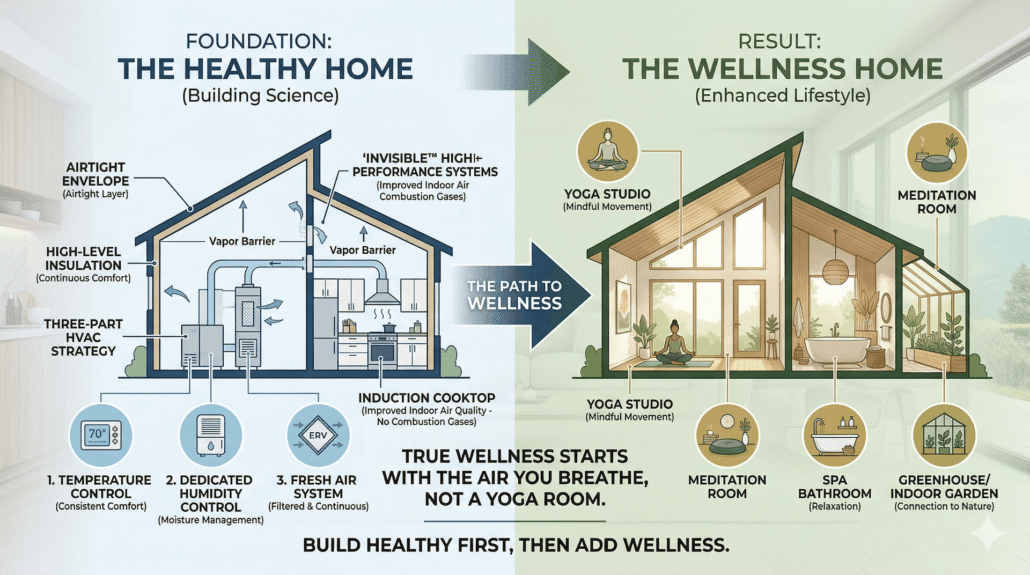
In today’s housing market, “wellness” has become a popular buzzword. You’ll see homes marketed with yoga studios, meditation rooms, spa bathrooms, and indoor gardens—all designed to support a better lifestyle. While those features can enhance your daily experience, they often miss a critical point: A home cannot truly support wellness if it isn’t healthy to begin with.
As a builder focused on high-performance and Passive House principles, we see a clear distinction between a healthy home and a home built for wellness. Understanding that difference helps homeowners make smarter decisions, especially when building new or renovating.
What Is a Healthy Home?
A healthy home starts with building science. It’s not about aesthetics or amenities; it’s about how the home actually performs.
In almost every home across Tennessee, standard construction practices rely on minimal insulation and allow for uncontrolled air movement. This results in indoor air that simply recirculates dust, allergens, humidity, and pollutants. A healthy home takes a completely different approach by focusing on a tight building envelope.
The Three-Part HVAC Strategy
When a home is airtight, you can no longer rely on random leaks for ventilation. We use a scientific three-part strategy to intentionally manage the environment:
Temperature Control: For consistent, year-round comfort.
Dedicated Humidity Control: To manage moisture levels and properly direct water vapor.
Fresh Air System (ERV/HRV): To continuously bring in filtered, clean outdoor air while removing stale indoor air.
The Role of Insulation and Energy Performance
We use significantly higher levels of insulation than standard construction. This serves two vital purposes:
Efficiency: It reduces heating and cooling demands, lowering utility costs.
Durability & Comfort: Better insulation keeps interior surfaces closer to room temperature. This eliminates drafts, cold spots, and noise. Most importantly, proper placement reduces the risk of condensation in the wall cavity, a leading cause of mold and structural deterioration.
Why Electric Appliances Matter
A healthy home also considers the air quality in the kitchen. Traditional gas appliances release combustion byproducts—including carbon monoxide, nitrogen dioxide, and excess water vapor—directly into your living space.
We prioritize induction cooktops for several reasons:
Health: No open flames or toxic combustion gases.
Precision: Faster and more accurate temperature control than gas.
Safety: The cooktop stays cool to the touch, and there is no risk of gas leaks.
So, What Is a Wellness Home?
Once you’ve built a healthy home—one with clean air, controlled humidity, and durable construction—you have the foundation for wellness.
This is where features like yoga studios, saunas, cold plunges, or greenhouses come into play. These elements support physical activity and mental clarity, but they are “surface-level” if the underlying home has poor air quality or hidden moisture problems.
The bottom line: You can add a beautiful yoga studio to a home, but if that home has uncontrolled humidity and recirculated allergens, it isn’t truly supporting your health.
The Roadmap: Build Healthy First
To create a home that actively supports how you feel, breathe, and live, follow this order:
Start with Building Science: Focus on the “bones” of the house.
Control the Environment: Ensure total control over air, temperature, and moisture.
Use High-Performance Materials: Prioritize insulation and airtightness.
Layer in Wellness: Add the amenities that enhance your specific lifestyle.
True wellness doesn’t start with a yoga room; it starts with the air you breathe.